
Disrupting 18 autism-associated genes produced shared changes in human neural cells
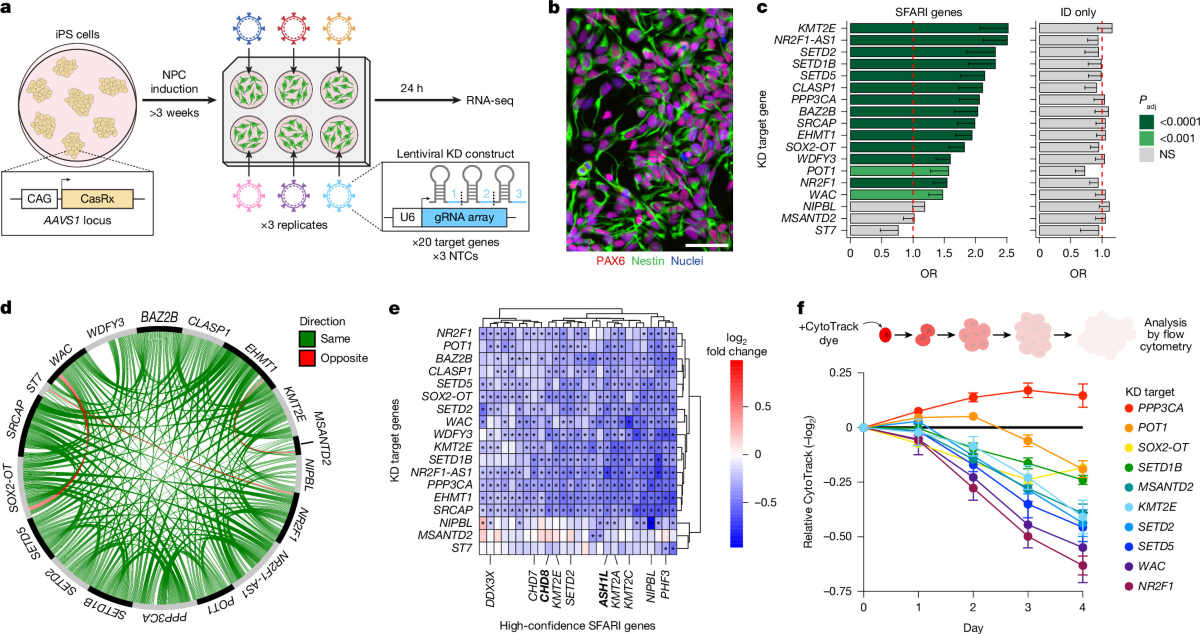
Reducing the activity of 18 autism-associated genes in human neural progenitor cells produced overlapping changes in gene activity, including widespread reductions in other autism-associated genes. The Nature study identified CHD8 and candidates including REST as central regulators behind these shared effects. ZFX, an X-linked transcription factor, also emerged as a key activator of many autism-associated genes. Transcription factors are proteins that control whether other genes are switched on.
The experiments used immature cells that give rise to cells of the nervous system, grown from one human male induced pluripotent stem cell line. These stem cells can develop into different cell types. Researchers initially reduced the activity of 20 targets, including two genes that produce RNA molecules that do not encode proteins.
To reduce each target's activity separately, researchers used CasRx, an enzyme that breaks down RNA. It belongs to the CRISPR family of tools for targeting genetic material. Three guide RNAs, molecules that direct the enzyme to its target, were used per target.
After 24 hours, researchers used RNA sequencing to measure the RNA produced by genes and assess changes in gene activity. The median number of genes with significantly altered activity was 920 per disruption. Two targets were excluded from further analysis because they produced too few changes. Each of the remaining 18 disruptions altered at least 287 genes.
In 15 of 18 experiments, or 83.3%, known autism-associated genes appeared among the altered genes more often than expected by chance. Genes associated with intellectual disability but not autism showed no such enrichment, suggesting that the disruptions particularly affected other autism-associated genes. CHD8 showed significantly reduced activity in 11 of 18 disruptions. Among genes with the strongest evidence of an association with autism, 27 were significantly altered in at least 10 disruptions, and all consistently showed reduced activity.
Researchers reconstructed a network showing how genes regulate one another to identify regulators behind the shared changes. Alongside CHD8 and REST, the analysis identified ZFX, which is expressed from both the active X chromosome and the inactive X chromosome in female individuals. Gene activity on the inactive X chromosome is largely switched off.
Autism is three- to four-fold more common in male than in female individuals. Female autistic people tend to carry more autosomal risk alleles, or genetic variants on chromosomes other than the sex chromosomes, compared with their male counterparts. Female individuals require greater autosomal genetic risk to develop autism compared with male individuals, an observation known as the female protective effect.
The authors proposed that higher ZFX expression in female brains could buffer damaging mutations in diverse autism-associated genes by helping maintain their activity, contributing to the female protective effect. The gene-disruption experiments used male-derived cells.
Written by the Genomes desk from the primary source cited and linked above and checked against it. Research use only; not medical advice. Corrections: [email protected].