
Ancient DNA favours eastern central European route for Celtic spread
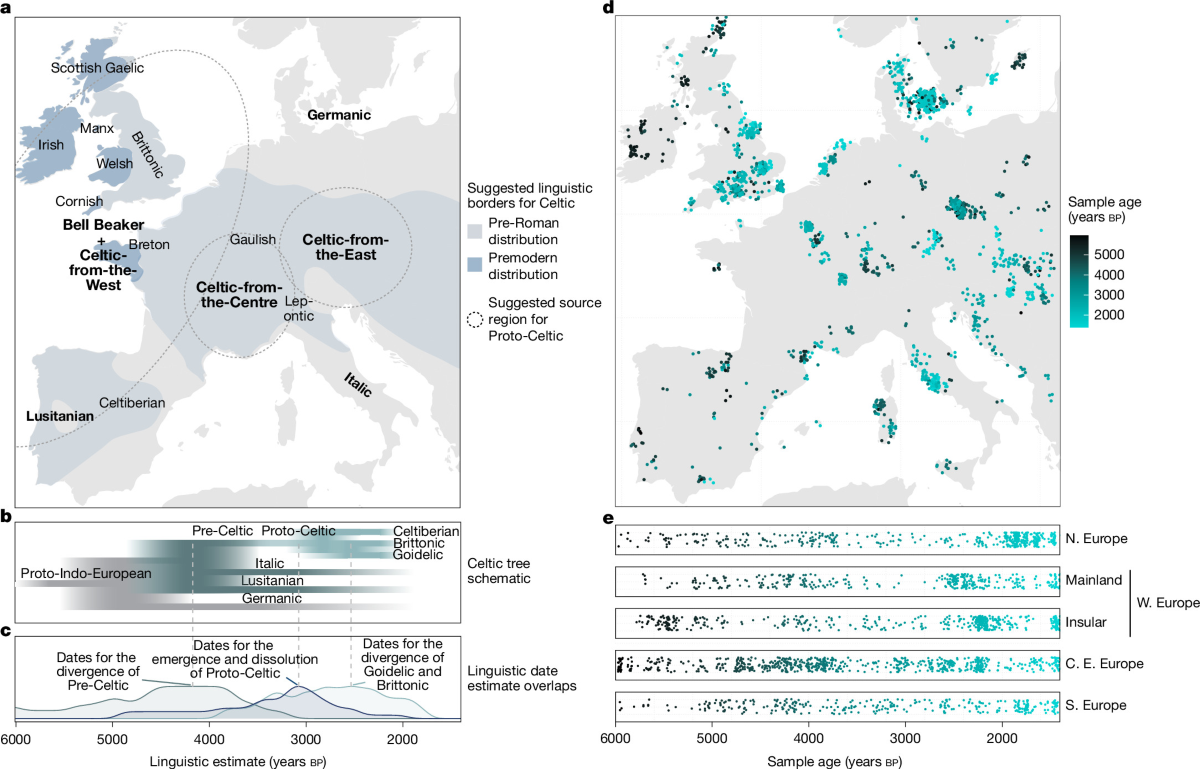
DNA from 4,587 ancient individuals favours a westward population movement from eastern central Europe as the explanation requiring the fewest assumptions for the spread of Celtic languages. The Nature study compared genetic evidence, mainly from Bronze and Iron Age Europe, with archaeological and linguistic models. Researchers identified three population movements relevant to those accounts. They favoured the latest, dated to 3200 to 2800 years before present, while cautioning that changes in language need not follow changes in ancestry.
The expansion carried ancestry related to Late Bronze Age populations associated with Knovíz and Urnfield archaeological groups. It affected France, the British Isles, northeastern Iberia and Italy. That ancestry was later associated with Iron Age Hallstatt and La Tène contexts, groupings of archaeological remains also linked to proposed accounts of Celtic dispersal.
Two earlier movements fitted aspects of other explanations. After around 4400 years before present, groups associated with Bell Beaker archaeology brought ancestry related to populations from the Pontic Steppe region across the area where Celtic and related languages were later spoken. A movement from southwestern Europe into Britain between 3800 and 3200 years before present was consistent with accounts placing Celtic formation along Europe's Atlantic edge. The dates use 1950 as the reference year.
The genetic evidence tests whether proposed language histories fit reconstructed population movements. It does not establish which languages people spoke. Although the authors favoured the movement from eastern central Europe, they acknowledged that human history does not necessarily follow the path requiring the fewest assumptions. Their use of population movements describes what happened without specifying the social mechanisms behind it.
The competing models place Celtic origins in different regions and periods. One connects its dispersal to Bell Beaker groups. Another proposes that Proto-Celtic, the undocumented ancestral language of all Celtic languages, emerged within Atlantic maritime networks. A further model places its formation in inland France and possibly northwestern Italy between 4000 and 3000 years before present. The eastern model places Proto-Celtic's formation in eastern central Europe and links its diversification to Urnfield, Hallstatt or La Tène archaeological contexts, or a combination of these.
The study addresses how Celtic languages became widely spoken across Europe during the Iron Age. Today they survive along the northwestern Atlantic fringe, including Irish and Welsh.
Written by the Genomes desk from the primary source cited and linked above and checked against it. Research use only; not medical advice. Corrections: [email protected].